Clegg DeMumbrie Richards

Clegg DeMumbrie Richards

I noticed that distant cousins, the descendants of Clegg DeMumbrie Richards, who is my great grand-uncle, visited Digging Up Your Family while searching for him (hi!  I’m waving to you!).  So I decided to post his obituary.  Though the family may already have this, other people out there might be searching for him and not have it!  This obituary appeared on Sunday morning in The Commercial Appeal on June 19, 1955.  It is transcribed below.

Clegg DeMumbrie Richards Obituary

EX-DETECTIVE CHIEF DEAD AT AGE 66

Clegg Richards Had Colorful Police Career

JOINED FORCE IN 1922

Clegg DeMumbrie Richards of 374 South Prescott, former chief of detectives with the Memphis Police Department, died at 2:55 yesterday afternoon at Kennedy Veterans Hospital after a long illness.  He was 66.

Mr. Richards’ colorful career as a policeman began in 1922, when he joined the force as a rookie patrolman.

Father Was Chief

His father, Jerome E. Richards, had at one time been chief of police, and his brother, Judge Ed Richards, was formerly a Criminal Court judge.

His rise in the department was rapid.  He became captain in charge of the auto theft bureau in 1930.  Seven years later he succeeded Will T. Griffin as chief of detectives, a post then designated chief inspector.  He resigned from the department in 1940.

During World War II, Mr. Richards was with the Office of Price Administration.  He retired about eight years ago because of ill health.

World War I Veteran

Mr. Richards was a World War I Army veteran, having served as a lieutenant.  He was a member of Idlewild Presbyterian Church and was a 32nd degree Mason and a Shriner.  He lived his entire life in Memphis and attended Christian Brothers College and the old Memphis University School.

He leaves his wife; a daughter, Mrs. Mary Dell Pollard of Memphis; a sister, Mrs. S.A. Para of Nashville, and two grandchildren.  National Funeral Home is in charge.

Inspector Clegg D Richards, Edmund (Edmond) Richards, (John) Spencer DeMumbrie and stories along the Mississippi River

I believe this newspaper article appeared in The Commercial Appeal, August 3, 1940.  It has been transcribed exactly how it appears in the paper.  Both Edmund Richards and Spencer DeMumbrie are my third great-grandfathers.


Article of Edmund Richards and Spener DeMumbrie The Commerical Appeal August 3, 1940 The article


Edmund Richards Edmund Richards


John Spencer DeMumbrie John Spencer DeMumbrie


Old River Boats Depended Upon Dozens Of Woodyards Scattered Along The Route

Police Inspector Clegg Richards’ Grandfathers Operated Two Of Largest-Abraham Lincoln Worked On Old Ferguson Farm Near Here

By Joe Curtis

For nearly 100 years Mississippi River steamboats used cord wood for fuel. Although coal began to come into service as a fuel early in the 50’s, it was not in general use until after the end of the Civil War and even then some boat masters believed good hickory or oak cord wood made a faster and hotter fire under the boats’ boilers.

For a number of years some of the largest woodyards along the Mississippi were located in Memphis territory, because for miles and miles the banks of the river were thick in forests of hickory, white oak, ash, and other hardwoods, which produced hot fires to generate steam rapidly an often saved a boat from falling in disgrace when racing another packet.

Many Yards Near Here

Between Memphis and just below Helena, Ark., there once were about 80 woodyards. In the vicinity of Memphis was the yard owned by Wappannocca Ferguson. Whether it was just above or below the city has never been determined, but a great many oldtime river pilots claimed it was in the big bend running the west side of President’s Island.

Anyhow, there is a story that Abraham Lincoln once worked for Mr. Ferguson. This is how it is supposed to have happened. Mr. Lincoln was returning to his home in Illinois, after making one of his famous flatboat trips down the Ohio and Mississippi to New Orleans between 1830-32. Not having much money with him, he and a number of companions engaged deck passage on an up-space boat.

Evidently, there must have been some slick fellows in the group, because when the boat went in at Wappannocca Ferguson’s to “wood up” Mr. Lincoln walked ashore and by mere chance met Mr. Ferguson. What transpired during their conversation is not known, but Mr. Lincoln said he had been “skinned” and he was given a job on Ferguson’s big farm and worked for him long enough to get money to pay his way home.

Invited to White House

When Mr. Lincoln was elected President of the United States, he extended to Mr. Ferguson a personal invitation to come and visit him at the White House in Washington, and it was accepted. Mr. Ferguson remained in Washington two weeks, so the old story goes.

E. M. Daugherty of Tunica, Miss., writes some valuable information on these old river woodyards between Memphis and below Helena. In a letter, he states that three big yards used to be at Ashly Point owned by Mr. Ashly, the other by a Mr. Clack, and the third by a Mr. Hutcheson. At Commerce, Miss., a man named Smith had a yard. At Mhoon’s Landing, Miss., there was Richards’ woodyard and not far from it was DeMumbrie’s Landing, Miss., and a big yard. Then came the yards at Whiskey Island, owned by Mr. Davis, one at Bordeaux Island, owned by a Mr. Goode. On Fox Island, opposite Austin, Miss., John McCann operated a yard and at Harbert’s Landing was the yard owned by Tom Turner.

Most all these famous landings have disappeared. The villages and towns that once thrived between Memphis and Helena have gone out of the picture, simply because they seem to have served there purpose and as Ol’ Man River had no further use for them, he simply changed his course, either washing away their very foundations or cutting out a new path for himself and leaving them miles away.

Old Pilots Would be Lost

In the bends from Helena to Memphis the changes have been so drastic and numerous no river pilot who ran the Mississippi in the days of Mark Twain would dare to attempt to handle a steamboat today through the sometimes narrow, twisted channels built up between sandbars of thousands of acres.

Mr. Dougherty writes interestingly of a double tragedy on Bordeau Island a number of years after the steamer Pennsylvania stopped at Goode’s woodyard to refuel and then exploded her boilers a few minutes after pulling away from that landing.

This Mr. Goode, writes Mr. Dougherty, always kept considerable money about his premises. His hired man, Charles Ibeck, suspected this and although he watched time and again to see where Mr. Goode hid his gold, he must have been unsuccessful, so he worked out another plan to rob him.

“One day,” continues Mr. Dougherty’s letter, “Ibeck came running to Goode’s house, telling him a cow had bogged down in some swampland. Mr. Goode and Ibeck hurried to the place to save the cow. When passing through a thick growth of underbrush and can, Ibeck, who had carried a axe with him, chopped Goode’s head open and he fell dead.

“Ibeck ran to the house after Mrs. Goode, telling her that Mr. Goode had been injured and she must hurry to him. She followed Ibeck into the canebrake and he slugged her to death with the axe. He then returned to the house and searched it for valuables. Some money was found.”

Took Boat North

The following day, so Mr. Dougherty states, a Cincinnati bound steamboat put in at Goode’s woodyard for fuel. Ibeck supplied her and engaged passage to Cincinnati. He took with him a team of horses, wagon and other valuable farming tools. But, the climax came when a packet from Napoleon, Ark., to Memphis landed at Bordeau three weeks later.

The captain of this boat had a hunch all was not right at Goode’s yard. He had not missed being hailed there in several years. Twice had he passed up the landing because there came no hail, but this afternoon he told the pilot to go in because he believed something was wrong.

Some of the crew investigated the premises. Finding no one in the house, they picked up tracks leading to the cane and swamps where they found the bodies of Mr. and Mrs. Goode. Picking up broken threads in the trail, caused the packet captain to trace Ibeck to Cincinnati. There he was investigated at a farm near the city. The team and wagon were identified and when confronted with his accusers, he confessed to murdering the Goodes.

Ibeck was returned to Austin, Miss., for trial. While in jail one day in 1869, three skiff loads of wood choppers came from Arkansas, battered their way into the jail at Austin, took Ibeck out and strung him
up. Mr. Dougherty said the sheriff at Austin then was Frank S. Belcher, who afterward became a big manufacturer.

River Took Plantation

Mr. Dougherty says there have been so many changes along the Mississippi since the day of the woodyard, rivermen of the 70’s wouldn’t recognize it. And, if these changes hadn’t taken place, Inspector Clegg D. Richards, Chief if the Detectives of the City of Memphis, might today be one of the biggest cotton planters in the State of Mississippi, for both his grandfathers, Col. Spencer DeMumbrie and Edmund Richards, owned the largest woodyards along the Mississippi, between St. Louis and New Orleans.

At the death of his grandfather, Edmund Richards, his big plantation on which was the woodyard and a fine colonial residence, was left to Jerome Richards, father of Inspector Richards. But the Mississippi kept gnawing away at it, cutting out acres at a time and carrying it down the river for miles to build up another man’s landholdings and make him richer. Finally, the Richards’ place had only 150 acres left. It was sold. Then what happened? “Well,” said Inspector Richards, “Lady Luck came onto the scene, took Ol’ Man River by the neck, forced him to change his course back like he was in the days of Grandfather Richards, so he built up the old plantation to a larger number of acres than originally were in it.”

And then, way back in about 1853, when the great steamboat Diana and Baltic raced from New Orleans to Louisville, the Diana being a mile or so in the lead of the Baltic when nearing Colonel Demumbrie’s woodyard, blew a whistle to refuel and a barge was taken in low and carried almost to Memphis before it was cut loose and floated back to its old home port in charge of a Negro slave, for both Colonel DeMumbrie and Edmund Richards were big slave owners.

Used Barges for Wood

Colonel Demumbrie is believed to have been the only woodyard man along the Mississippi to own a fleet of barges on which cord wood was loaded for ready use. If a boat went upstream, it towed the barge until unloaded and it floated down to the landing with an attendant guiding and propelling it with a log sweep-like car. If the boat taking a barge in tow was going downstream, the barge was landed at some point for the first upboat to take back to DeMumbrie’s Landing.

The DeMumbrie residence was said to have been the finest along the Mississippi this side of the plantation homes in the Louisiana. Colonel DeMumbrie’s long record of service to the United States went back a long way. He accompanied the Rogers an Clark expedition to the Northwest and upon returning, went to that point along the Mississippi River where he established his woodyard. Mrs. Demumbrie died leaving a little girl. She had been christened Minnie and was reared by a Memphis relative. It was Miss Minnie DeMumbrie who married the late Jerome Richards at Central Baptist Church.

Today, there isn’t a grain of sand left where DeMumbrie’s woodyard and stately plantation residence stood. It wasn’t far from Mhoon’s Landing and the ground on which it stood is now the Mississippi River.

Edmund Richards, father of the late Jerome Richards and Miss Caroline McQueen were married. And there again is a family tree with its branches reaching back to Colonial Days, for Miss McQueen was born on May 11, 1826, a daughter of Peter and Elizabeth Freeland McQueen. Edmund Richards settled with his bride on his Mississippi River plantation where he saw steamboating grow from its crudeness to its greatness and now, his grandson, Inspector Richards, points with pride to the days when as a little boy, he rode the old Kate Adams to his father’s cotton plantation and in later years he with other members of the family heard about the cruel Mississippi taking most of it away. That is when his youthful dreams of becoming a rich cotton planter came to an end, he says.

Elizabeth Freeland

Since I find it very important to make sure that the women of my family are remembered (and not just brushed off to the side as they were in the past) I started my research on Elizabeth Freeland, the wife of Peter McQueen, the mother of Caroline McQueen and my 4th great-grandmother.

Since I just started my research, I don’t have too much to offer right now.  But what I have found is pretty interesting.

What I do know about her is that she married Peter McQueen on November 27, 1820 in West Feliciana, Louisiana.  She had at least three children:  Loceisa (which could be a misspelling, misread) in about 1822, Malissa (possible misspelling again) in about 1824 and Caroline in 1826.  There may have been more, though what I found today leads me to believe that Mary McQueen, age 18, listed on the 1850 census living with the Richards family, may not be Caroline’s sister, or at least not her full sister.

I found a divorce record for Elizabeth and Peter.  The divorce was finalized on May 22, 1838 in Mississippi.  The little information listed for the divorce records are:  Peter may have deserted the family in 1827.  At some point Elizabeth wanted to sell some land.  Peter returned in 1837 and left at some point with the two oldest children, possibly taking them to Arkansas.  The divorce record also states that Elizabeth had an older brother by the name of George W Freeland and that he had recently passed away in Sumter County, Alabama (though I haven’t found his death, I found a person that might have been him in Alabama in Sumter County and also in Marengo County). 

I am ordering the divorce record to see if there is any other information in it.  I recently heard from the Lauderdale County, Mississippi Historical Society (Lauderdale County is where the divorce took place) that the record is 18 pages long!  Surely it’s a wealth of information, right?  (I just hope it’s readable!).

I think I should take the time here to leave a little note for historical societies across the world:  Lauderdale County Historical Society does it right.  They have a form that you can fill out with what you are looking for.  They will then respond immediately to let you know they received your request.  Then they search for your record and send another email letting you know if it can be emailed or if it will need to to be snail mailed and the price, asking if you are still interested.  THEN you have the option of sending a check or money order OR paying through Pay Pal!  YES!  This means that they get paid quicker, I get my information quicker and everyone is happy in the end.  Take note, historical societies!

Caroline McQueen UPDATED

UPDATE:  Rather than rewrite the entire thing, I am just adding this update:  according to a newspaper article concerning Edmond Richards and Spencer DeMumbrie (which will be transcribed in another post!) Caroline McQueen's parents were Peter McQueen and Elizabeth Freeland.  The article also states her birth date as May 11, 1826.  ALSO, the article states that Edmond settled with Caroline in Mississippi, however, as you can see below, she couldn't have.  Edmond isn't found in Mississippi on the census records until 1870, after Caroline had passed.  One last thing:  the baby book of Caroline's great-grandson, James Paul Stalls Jr-my granddaddy-(1917-1987) has Caroline's name spelled Carolyn.)

There are exactly two records that I have found regarding Caroline (Carolyn, Carolin) McQueen and her (probable) short life.

I haven’t yet figured out who Caroline’s parents are, but I do know that she was born about 1827 in Mississippi.  The death certificate of one of her children says she was born in North Carolina (but we all know how accurate those are, right?).

On March 14, 1846 Caroline married Edmond Richards in Crittenden County, Arkansas.  She was 19 years old and Edmond was 23 years old.

Edmond Richards and Caroline McQueen Marriage Record

The only other record I can find of Caroline is the 1850 census enumerated on October 26, 1850 in Tyronza Township, Crittenden County, Arkansas.  She is listed as Catherina, age 22 years old.  Edmond is listed as Edward, age 25 years old.  They have two children, George (age 3 years) and Lucy (age 2 years).  Also in the household with them are Mary McQueen (age 18 years), who I presume is Caroline’s sister, and Mary Edwards (age 14 years), who I cannot figure out who she is or why she lives with them. 

(note: the family lives next door to Edmond’s widowed mother, Rhoda.  Rhoda took care of her adult daughter Susan, known as Sukie, who is listed on the census as “idiotic”.  According to Earle Epic by Gladys Wright and Committee Members-no further information on the book-“Sukie’s mind had been affected by some illness so that it never matured”.)

In 1860 the Richard’s family is found on the Eastland, Texas census.  Edmond (shown as Edmund, age 37 year) is the only parent.  The children listed are:  George (age 12 years), Laura (age 10 years), Alice (age 8 years), Marshall (age 6 years) and Jerome (age 4 years).  There is also listed Melissa Richards (age 16 years) that I think is Edmond’s niece from his brother John.

So, if Caroline died then it happened between February 20, 1856 (her son Jerome’s birth date) and August 13?, 1860 (the day the 1860 census was enumerated…I can’t quite make out the day).  I can only imagine she passed away.  The alternatives are she either ran away or divorced.  I just know I haven’t found her on the Mortality Schedules.  Yet.

Solving One Mystery Can Lead To Another

The question kept coming up of why wasn’t my granddaddy, James Paul Stalls Jr (1917-1987) on the 1920 census with his parents. I just couldn’t understand where he could have been, since he would have been about 3 years old (depending on what month the census was enumerated). The Census record I found that his parents were on was done on January 17, 1920 in Memphis, Tennessee. You can plainly see that his parents are living with the Richards family (James Paul Stalls Jr’s mother’s family). Listed are Jerome Richards (Minnie’s father), Minnie Richards (Minnie’s mother), Paul Stalls (granddaddy’s father), Minnie Stalls (granddaddy’s mother), Bluford Richards (granddaddy’s uncle), Willie Richards (Bluford’s wife) and Nannie Taylor (the servant/nanny).

1920 Memphis, Tennessee Richards Family with Stalls family

The possibilities of why he wasn’t living with them were A) perhaps that’s when he had scarlet fever and maybe he was in the hospital-but you would assume they would still have listed him as living in the household with the family, or B) maybe he was living with his grandparents, James Paul Stalls Sr’s family. So I looked them up.

Lo and behold, there he is. But wait! His parents are there, too! Listed (and misspelled) are Frank Curtius and Mary Curtius (JPS Sr’s step-father and mother). Mary’s mother is also there, Francis Bondurant. What’s this? The STALLS family is listed as Curtis’? Crazy! But there they are! Paul Curtis, Mamie Curtis and Paul Curtis Jr. That’s not right, is it? Nope. As you can see, Curtius is misspelled. As is Bondurant. Minnie’s name is written as Mamie. And Paul Sr, Minnie and Paul Jr should all be Stalls. I’m not even going to get into the age differences (only two of the ages listed are correct).

1920 Memphis, Tennessee Curtius Family with Stalls Family

So the Curtius census was enumerated on January 3-4, 1920, also in Memphis, Tennessee.

The questions this raises are: was the Stalls family actually living with the Curtius family and moved within the 14 days between enumerations to the Richards household? Was granddaddy living with them after the move or was he in the hospital (we need to find out when he had scarlet fever)?

This isn’t the first time that someone is listed on more than one census record for the same year. Another example (which this may or may not be the same person, but the names and ages are the same):

My mom noticed on the House of Proctor website that someone had cited the 1870 Nashville, Tennessee census, enumerated July 15, 1870, as listing Amanda Summers. She is 18 years old and is a boarder in the Wyatt household.

1870 Nashville, Tennessee Wyatt Family with Amanda Summers

In the 1870 Stewart County, Tennessee census, enumerated August 22, 1870, Amanda is living with her parents, Pink and Emily, her siblings, Greenberry and Clementine, and two boys that may or may not be her siblings, Anderson and Rufus (in another post I mentioned that they were not on the 1860 census, even though they would have been 5 and 3 in that year). On this census Amanda is 18 years old, but it isn't actually listed how she is related to the Summers family (but we know she is the daughter, according to other census records).

1870 Stewart County, Tennessee Summers Family

So, the questions raised by these census records: if the Nashville, Tennessee census is our Amanda, is it possible that she went to Nashville to give birth to Lizzie? If so, where is Lizzie (that question is going to haunt me until I find the answer!)? Either way, Lizzie isn’t listed as living with her on either census. It’s just so strange.

Guest Post: Stories about Minnie Virginia Richards

Grandmother Para

by Virginia Marie Stalls

Minnie Virginia Richards

Grandmother was a lot of fun to be around, and I loved spending at least a week in the summers with her and Grandaddy.

She and he would banter back and forth, and she and the housekeeper would do the same thing. I would just sit and laugh.

I learned a lot from her. She taught me to hold a pencil between my teeth when I spoke because "young ladies don't open their mouths very wide when they speak." She corrected my pronunciation from "git" to "get as in bet." When I had trouble with "W" and "M" learning to write she told me that water starts with "W" and that it would hold water. If you put water in "M" it would fall out. I learned to set a proper table. She would briefly look it over and say that we would have our meal when the table was set correctly. Usually it would be a knife with the blade facing the wrong way. She went to finishing school as a young girl, but I had my own private tutor!

Whenever she went anywhere, including the grocery store, she would be dressed very nicely and wearing a fur coat in the winter. She was definitely patient with me because I loved to stroke the fur.

She took holidays very seriously and decorated elaborately for Christmas. Whether it was Easter, Thanksgiving, or Christmas the table was full of her special dishes, and she was a great cook. I think my favorite was her oyster dressing with giblet gravy over it. For Easter she and Granddaddy spent time dyeing eggs, and Daddy would gold leaf one for the grand prize of 50 cents, I think it was, for the lucky person who found it.

They lived on Old Hickory Lake in Hendersonville, TN when I was in junior high school. The owners of the house lived in the downstairs basement. There was a sunroom across the back of the house overlooking the lake. The owners would have parties, and country music stars attended. Grandmother pointed out to me who was there, and I can only remember Little Jimmy Dickens now.

When they moved from Nashville to Memphis I was in high school and would save my money to catch the train to go to visit with them. Later when I was a young adult and lived in Memphis Grandmother wasn't driving anymore. Her friends would pick her up about once a week or so to get together for cards. She would ask me to watch her soaps (Guiding Light, As the World Turns, and Secret Storm) so that she wouldn't miss anything.

Another thing she would ask me to do is to sneak Fate magazine to her and not to let Granddaddy know. She firmly believed in the supernatural and enjoyed reading about it.

She had a lot of plants by the sliding glass door going onto the balcony, and Granddaddy called it a "jungle."

What few stories about her childhood would come out usually at the prompting of my father if he was there. The one story I can recall right now is that as a child she refused to go to sleep until one of the housemen came to her bedroom and played the fiddle for her.

Another story involved a dinner at a Chinese restaurant in New York City. She asked their host what the gristly things were in her food, and he said it was rat tails. She promptly got up, went outside, and proceeded to throw up in the gutter. It's hard to imagine my proper grandmother sitting on the curb in NYC.

She liked corned beef sandwiches and chocolate éclairs a lot. Before I got the call that she had died I had spent the day craving those foods and wanting to shoot pool. She liked to play snooker. That day she and Grandaddy were getting ready to go to Nashville for a political convention. I talked to her the day before she died and she said she hadn't been anywhere in a long time, so she was really excited about going. She had just gotten out of the shower and sat down telling Granddaddy that she didn't feel well, and then she suddenly slumped and died.

Her funeral was a full Catholic funeral, and she is buried in Forest Hill Cemetery in Memphis with her family around her. There is a monument with the Richards name where her parents and siblings are buried right near her grave. Her headstone is set flat, and Granddaddy is buried beside her.

Will Knoles

Before I get started on Will Knoles I just want to put out there that I cannot verify that all of these records are the same person. I also can’t verify that all of these records pertain to the person my granddaddy, James Paul Stalls, Jr (1917-1987) viewed as a father figure. That said, tracking African American families can be a very difficult task. Due to social views of the times it appears that it was not as important to document our African American citizens. So what follows is what I have found and what I know.

On the 1910 Memphis, Tennessee census Will Knoles is found living with the Richards family. He is documented as Black, age 22 years, born in Alabama. His occupation is servant. He is single. It says that his parents were both born in the United States, but it doesn’t give an exact location. I don’t know if this means that he didn’t know, or the enumerator didn’t care. Will is able to read and write. He is working on his own account. He had been out of work for 8 weeks in 1909.

With that information I can only assume that the “Old Will” my granddaddy spoke about so fondly is Will Knoles. Of course, if it is, then we can’t figure out why my granddaddy would refer to him as “old” being that he was only 29-30 years older than granddaddy (unless, as my mother pointed out, any adult was seen as old…and of course, the older Granddaddy became the older Will would get, too!). I also can’t figure out where he was living when my granddaddy was small since he is not found on the 1920 census (but then of course, neither is my granddaddy! Maybe they were off together somewhere!).

When searching for Will Knoles born in Alabama about 1887/1888 I find a 1900 census record enumerated in Girard, Russell County, Alabama. On this census “Willie” Knoles is 13 years old and living with his grandparents, Frankney Knoles(66 years), a day laborer, and Axie Knoles(57 years) and his siblings, Charlie Knoles (10 years), Alburta Knoles (8 years) and Lewsile Knoles (6 years). Interestingly enough living next door to them are “Pe Ke” Knoles and Sallie Knoles. I suspect that “Pe Ke” is Willie’s uncle, Frankney and Axie’s son. Axie is listed as being the mother of two children, one of whom is still living.

The only other record I can find of this family is in 1910 in Girard, Russell County, Alabama. The family, now listed as “Knowles”, consisted of head-of-household “Frank”(79 years, now widowed), son “PK” (32 years, also widowed), grandson Charlie (19 years), granddaughter Alberta ( 18 years) and granddaughter Jennie (16 years).

So, back to Will.

The next time I am able find anything for Will Knoles is a WWI Draft Registration Card, signed in 1917 (the year my granddaddy was born). The information provided on this document is: his name is Will Knoles, age 28, and he lives at 519 Edith Avenue, Memphis, Tennessee. His birthday is September 15, 1889 (which is a reason I question the 1900 census as being him seeing as it gives a birthdate of May 1887-unless his grandparents just didn’t know). He is shown as a “natural born” citizen and it shows his place of birth as Memphis, Tennessee (again, raising questions since the 1910 census says he was born in Alabama). He works as a concrete finisher for James Perryman. He is married with a wife, children and brother that are solely dependent on him for support. He is shown as “negro” and has not served in the military, nor is he exempt from draft. He is 5’2 and of medium build with dark hair, dark eyes and he is not bald. It doesn’t actually say if he has all of his appendages, but we will assume he does.

Will Knoles WWI Draft Rgistration Card

So, is this the same “Old Will”?

The only other record I can find for any Will Knoles born around 1887-1889 in Alabama listed as “Black” is the 1930 census enumerated in Miami, Florida. This man is listed as “William Knowles” and it says that he was 34 years old the first time he was married. I don’t believe that this is our guy at all, but strange that he is the only other person with a similar name, date of birth and place of birth as who I am looking for.

So what ever happened to “Old Will”? Where are his descendants? Granddaddy used to follow him around everywhere he went. He taught him how to catch birds with a box, a stick and a string. Granddaddy’s grandmother, Minnie, would have “Old Will” catch birds in the yard for her to cook.  They used to hunt rabbits on the land around what is now Graceland.

I will keep looking for him and his family. I hope I can find them.

Minnie DeMumbrie

Minnie DeMumbrie

On May 13, 1858 Minnie DeMumbrie was born in Mississippi, most likely in Tunica, to (John) Spencer DeMumbrie (1821-?)and Cornelia A McMillan (1833-before 1870).  She was the granddaughter of Jean Baptiste DeMonbreun (1788-1872) and the great-granddaughter of Timothy Demonbreun (Jacques-Timothée Boucher, Sieur de Montbrun) (1747-1826), the man considered the “first citizen of Nashville”.

On the 1860 census in Tunica, Mississippi she is 2 years old and living with her parents on a plantation (value of the real estate was $10,000 and the value of the personal estate was $6000).  Her father is listed as “S. DeMumbrie”, a farmer, her mother is listed “C.A. DeMumbrie”.  Minnie is listed as “C.A.M. DeMumbrie”.  I read my aunt’s post on a genealogy forum that the full name of Minnie’s mother was Cornelia Ann Minerva McMillan.  If so Minnie may have been named after her and “Minnie” may have been a nickname.  Their neighbors in 1860 were the Owens family and the Roberts family.

In 1870 Minnie (listed as “Clara”) age 13, is living in Tunica, Mississippi with her father, who by now is widowed and listed as a “planter”, and three other people.  Jane (Gilcris?) is one member of the household that, at some point, married Spencer.  I believe Mary McMillan, listed as a housekeeper, is Minnie’s maternal grandmother.  The third person is Ellen Johnson.  I haven’t quite figured out how she is related to the family yet.  She is listed as 60 years old and no occupation.  The DeMumbrie’s neighbors are the Johnson family and the Richard’s family.  Included in the Richards family is Jerome Richards, age 14-Minnie’s future husband.

By 1880 Minnie had married Jerome E Richards.  The Tunica, Mississippi census for that year shows that she is listed as “C.A. Richards” and she is living with Jerome (a farmer), her son JE (Jerome Jr-Eddie), MH McMillan (her maternal grandmother again, I believe), and three others listed as farm laborers and a servant, or boarders:  JA Matthews, Ellis Sholly and Barbara Shipp.  Their neighbors are the Bullock family and, if I am reading it correctly, the Shearings family.

There is, of course, no record of the family for 1890.

In 1900 the Richards are living in Memphis, Tennessee.  Jerome, by now the Chief of Police for the City of Memphis, and Minnie have five children:  Eddie (Jerome Jr), Claud E, Bluford (Napoleon), Clegg, and Minnie (Virginia).  Also living in the household are Frank Macon, John Smith and George Smith, who are all three listed as servants.  This census also tells us that Minnie is the mother of six children, five of whom are living.  The sixth child was George Richards, born in 1892 and died in 1894, no further information on him (buried in Forest Hill Cemetery, Memphis, Shelby County, Tennessee).  The neighbors of the Richards family were the Kean family and the Piaggo family.

In 1905, on December 4th, Minnie watched in horror as her son, Claud E, shot himself in the parlor of their home.  She held him in her arms as he lay dying.

The year 1910 leaves Minnie living with her husband Jerome, now a criminal court clerk, Bluford, Clegg, Minnie Virginia, cousin Dick Richards and servant, Will Knoles (post about him to come soon!).  This census, too, was enumerated in Memphis, Tennessee.  Their neighbors were the Borner family (if I am reading it correctly) and Old Widow Hall (Jane Hall). 

By 1920 Minnie, now reported at age 61 and still residing in Memphis, Tennessee, is living with husband Jerome, son-in-law James Paul Stalls, Sr, daughter Minnie Virginia, son Bluford Napoleon, daughter-in-law Willie D and Nannie Taylor, servant/nanny.  Oddly enough James Paul Stalls, Jr, Minnie’s grandson, who would have been 3 years old in 1920, isn’t on the census with them.  I wonder where he was?  The families that were their neighbors were the Borners and the Maingaults.

I found a property record that shows that Minnie sold a tract of land to a Nannie Brown on January 15, 1927.  I can’t quite make out the record, but here is what I was able to get from it:

The _____ 33 1/3 feet of dist Eight, Block “B” of Stephens Subdivision beginning in _____ side of Wicks (Ave?) __5 1/2 feet _____ of H____ road.  Hence _____ with Wick’s Avenue _____, 33 1/3 feet.  Hence _____ 136 ?/10 feet to use _____;  Hence _____ with said _____, 33 1/? feet;  Hence northbound 136 8/10 feet to the point of beginning.

I will need to do more research, but I think that this Nannie Brown might be the nanny, Nannie Taylor, listed in the 1920 census with the family.

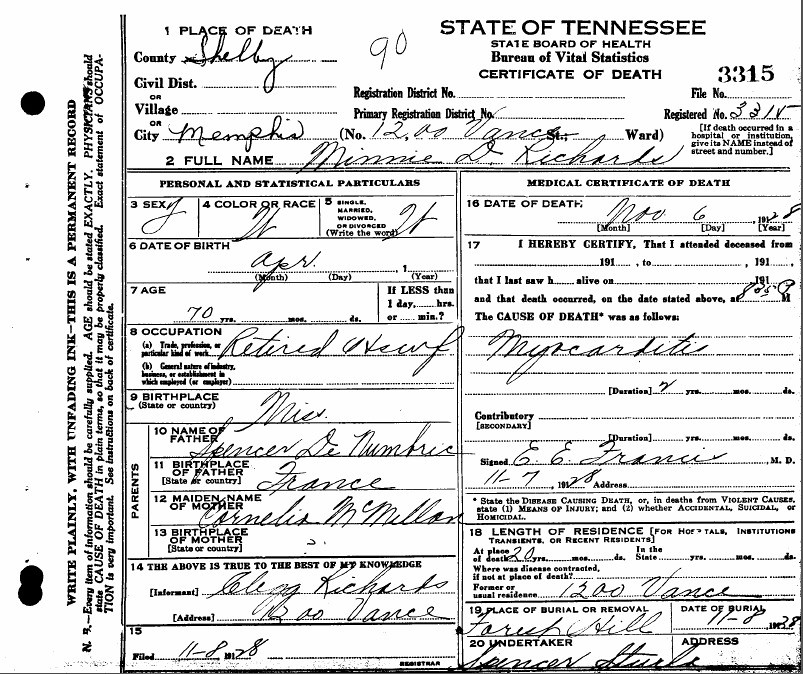
Minnie DeMumbrie passed away at 8:35pm on November 6, 1928 in Memphis, Tennessee.  The cause of death was myocarditis, which, according to the death certificate, she suffered from for 2 years.

Minnie DeMumbrie Death Certificate

Minnie DeMumbrie is buried in Forest Hill Cemetery Midtown, Memphis, Shelby County, Tennessee.

One story that my mother can remember her father telling her about Minnie:  Granddaddy referred to Minnie as his “French Grandmother” and he told of how she would have Will Knoles trap birds (sparrows and such) in the yard.  He said that she would keep the little dead yard bird bodies in the ice box.  Apparently when he would eat chicken it reminded him of those little birds!

James Paul Stalls, Sr

James Paul Stalls, Sr

Though the death certificate, and obituary, for James Paul Stalls, Sr says he was born in Obion, Tennessee, no proof has yet been found confirming that.  In fact, Obion County Historical Society has no record at all of his parents, James Franklin Stalls (1857-1889) and Mary J “Annie” Bondurant (1867-1950), or him ever being in Obion or Obion County (though according to his father’s marriage bond and obituary, that’s where James Franklin Stalls was “from”).  And census records report that he was born in Kentucky.  What we do know for certain about the birth of J. Paul is that it occurred on June 12, 1889.  Six months and 7 days after his birth his father passed away due to pneumonia.

When J. Paul was 3 years old he moved to Memphis, Tennessee with his mother and his grandmother, Elizabeth Francis “Betty” “Fannie” Brewer (1845-1922) (widow of James M Bondurant (1842-1886)).  On the 1900 census he is living with his mother, who ran a boarding house.  By 1910 his mother had remarried to Frank A Curtius and they were living with Annie’s mother, who was running a boarding house.  J. Paul’s occupation was Professor of Music. 

He married Minnie Virginia Richards July 27, 1914.  It was a large affair, including a write up in the Commercial Appeal concerning the musical playlist, performed by Enoch Walton (organist), Mrs. CW Parke (soprano) and Mrs. SH Lambert (violinist).  In 1917 his son, James Paul Stalls, Jr (1917-1987), was born.

In the 1920 the census J. Paul is living with his bride, her parents, two of her brothers, a sister-in-law and Nan, the nannie.  Oddly enough, though, his son isn’t listed on that census.

J. Paul’s WWI Draft Registration Card says that he is of medium height, medium build, blond hair, blue eyes, is not bald and has all of his appendages. 

James Paul Stalls, Sr WWI Draft Registration Card 

In 1921 he opened the J. Paul Stalls Studio at Third and Jefferson in Memphis, Tennessee.  He later moved his school into his home and continued teaching for many years, even after he was bedridden.  His students would be in the other room and he would know which one made a mistake and call out to them.

J. Paul and Minnie divorced August 10, 1926.  He married Evelyn Mozelle Fitzgerald (1905-1994), a music teacher, in 1928.  They appear on the 1930 census together living with his mother and stepfather.

James Paul Stalls, Sr and Evelyn Mozelle Fitzgerald

James Paul Stalls, Sr died on January 21, 1951 in Memphis, Tennessee from broncho pneumonia due to Parkinson’s Disease.  He had a Masonic funeral and was interred in Memorial Park Cemetery in Memphis, Tennessee.  In his will he left all but one dollar to his wife, Evelyn.

James Paul Stalls, Sr Death Certificate

J. Paul had quite an impressive list of accomplishments under his belt.  He was an organist and pianist and he taught organ, piano and violin.  He was associated with all music events that occurred in Memphis.  He was the organist and choir director for McLemore Avenue Christian Church, Idlewild Presbyterian Church and Christian Science Church, all in Memphis.  He studied piano under Mrs. ET Tobey of Memphis and was a pupil of R Jefferson Hall of Memphis, studying organ and harmony.  He completed his formal education over the course of six summers in Chautauqua, New York under Mr. William H Sherwood.

J. Paul had also been a member, registrar and examiner of Tri-State Musical Examining Board.  He was a member and former president of the Memphis Federation of Musicians and former dean of the Tennessee Chapter of the American Guild of Organists, and he was also a member of the Beethoven Club.

A Scottish Rite Mason, he was a member of the Leila Scott Lodge and he was a Shriner.

In hopes of alleviating the symptoms from his Parkinson’s Disease, J. Paul joined the Christian Science Church.  He was, at one time, at a Christian Science asylum for treatment of the disease and one of the treatments was to eat peels from the fruits and vegetables.  From my  mother: “Presumably at the Christian Science Church he would sit in the organ loft in his wheel chair, perhaps to oversee the organist. The organist was particularly concerned about one particular piece to be played, so JPS was wheeled up to the organ where he stretched his hands out over the keys. He was so focused that there wasn't any tremor visible as he flawlessly played the piece. At the conclusion of it he pretty much collapsed and resumed the tremors.”

I hope to tell more stories of James Paul Stalls, Sr in the future!

The Craft Family and the Melungeons

Several years ago a descendant of the the Craft family presented to my mother in an email the theory that the Craft line extended back to the Melungeons that originated in the Southeastern part of the United States: North Carolina and South Carolina into Tennessee and parts of Virginia, Kentucky and so on.  If you don’t know about the Melungeons there is a website with a ton of information that I found through the Lost Colony/Melungeon Lore DNA Project, Melungeon Heritage Association

There are several theories on the origin of the Melungeons, one being that the members of the Lost Colony of Roanoke may have travelled to Croatan Island and blended with the Native inhabitants.  Another theory, of course, is that the colonists were attacked and murdered by the Natives. 

In general it is thought that the Melungeons are a grab-bag mix of Native Americans, freed black slaves, Portuguese and white European settlers.  DNA tests show that the genomes of known Melungeon descendants correlate with all of these groups. 

Census records show us that these families all had appearances that did not allow them to be categorized into mainstream society.  They were usually listed as black, Indian or mulatto.  In general they may have had European features, but with darker skin.  Or some of their features may have been more African than European.  There are photos that can be found online of known Melungeons.  Some I see and I think that I never would have noticed a difference.  Some I see and, though the features are clearly European, their skin is very dark.  I have even seen photos of people with blonde hair and very dark skin.  As time went on and the Melungeons mingled and married those with predominately European ancestry their successors slowly became accepted as “white”. 

So when my  mother introduced me with this family theory, I decided to check it out.  Because my autosomal DNA matches so many different world populations I am comparing it to different people of known Melungeon origins.  This, of course, takes more research, but it’s pretty intriguing.  This may explain why members of my direct Craft family get so dark in the sun so quickly.  And though we know there is Native American blood, there may also be Melungeon.

A woman in the Lost Colony/Melungeon Lore DNA Project also has Crafts in her family.  If I can find if and how her Crafts are from the same line I may be able to say unquestionably that, yes, our Crafts are descended from Melungeons.

I am still researching them, but here’s what I have so far (that I am certain of), following my direct line (this in no way represents all of the offspring from each couple, only my direct line):


Thomas Craft (abt 1810-?)

Dicey Unknown (abt 1822-?)

According to census records Thomas was born in North Carolina. Both his mother and father were born in South Carolina. Dicey was born in Tennessee and both her mother and father were born in South Carolina.


John Craft (1867-1931)

Epanetes (Eppy) Willhite (1869-?)

John Craft was born in Tennessee. Census records state that his father was born in Tennessee, so either the census taker or John himself made a mistake.


Henry Corbett Craft (1895-1971)

Katie Clady Cathey

Corb was born in Hickman County, Tennessee. Katie was born in Indian Bayou, Lonoke, Arkansas.


Ruthie May Craft (1925-2007)

James Paul Stalls, Jr (1917-1987)

Both Ruth and Paul were born in Tennessee.


I have read on websites many different surnames for Dicey.  I have also seen many different fathers listed for Thomas, with the most promising being a Charles Craft from South Carolina.  Until I have confirmation on these names, however, I cannot actually add them.

On an interesting side note, I read on Wikipedia that an anti-illegal immigration group is using Virginia Dare, the child of , more or less, illegal immigrants (the Native Americans sure didn’t want them on their land) as the namesake and symbol of their group.