Timothy Demonbreun’s Windows

Since I have been working on posts about Timothy Demonbreun, I figure I should post an advertisement he placed. 

This is definitely the earliest newspaper mention I have found of Timothy so far.  I found this advertisement in the February 11, 1801 issue of the Tennessee Gazette, Nashville, Tennessee.  I’m wondering if this was when he sold his tavern to Elizabeth Bennett.  Maybe she wanted her own windows.

Timothy Demonbreun Wed Feb 11 1801 Tennessee GazetteEXCELLENT

WINDOW GLASS

FOR SALE

At T. DEMUMBRUNS,

IN this place, by the box or less quantity, very low for CASH.

Nashville Feb. 10th, 1801.

Timothy Demonbreun and Thomas Sharp Spencer: Friends or Foes?

When I was little my mother told me about my ancestor who lived in a cave and his best friend who lived in a tree.  Somehow over time, or perhaps I just wasn’t paying attention (most likely), I thought that she said my ancestor lived in a tree.  In my childish imagination I conjured up something like Swiss Family Robinson and thought how fantastic it would be to live in a treehouse.  Later, I realized that the reason the story was told to me is because supposedly (family lore) my 3rd great-grandfather John Spencer DeMumbrie was named after this treehouse man.  Now, I can’t disprove this story.  But I can tell you the story of Thomas Sharp Spencer.

Most everything I can find on Thomas Sharp Spencer comes from the 1908 book Early History of Middle Tennessee by Edward Albright (another public domain book!).  Here’s his story:

Described as a long-hunter by the Mansker Chronicles, Thomas Sharp “Bigfoot” Spencer was born about 1758 in Virginia.  He traveled from his home in Virginia to Bledsoe’s Lick, now Castalian Springs, Sumner County, Tennessee, about 7 miles northeast of Gallatin, Tennessee and about 36 miles northeast of Nashville, in the Spring of 1776.

Now, Albright says that Thomas and a friend of his planted in the summer and reaped corn in the Autumn of 1776, thus being the “first crop of grain in Middle Tennessee”.  I would like to point out that the Creek, Choctaw, Cherokee and Shawnee had lived in the area for YEARS.  So it most definitely wasn’t the first grain crop.  In addition, other settlers had crops, so it is doubtful that it was even the first grain by a settler.  Perhaps the first on record? 

So, the tree.  Legend has it (along with a pretty nifty drawing) that Thomas lived for at least three years in a hollowed out Sycamore tree, dubbed “Spencer’s Tree” or “Spencer’s House” by the other people in the area.

spencerstreeThomas Sharp Spencer and his hollow tree (source Early History of Middle Tennessee by Edward Albright)

He eventually built himself a house on a large parcel of land, which was named “Spencer’s Choice” due to him being forced in 1781 by North Carolina to choose a parcel out of four (North Carolina having owned that part of Tennessee at the time).

spencerschoiceSpencer’s Choice (source Early History of Middle Tennessee by Edward Albright)

In the Fall of 1793 Thomas was returning to Spencer’s Choice after making a trip to Virginia when he was attacked and killed by a band of natives that were lying in wait.

He never married and never had children (that anyone is aware of, at least).

Something I found amusing when I was searching around came from the 1909 book Historic Sumner County, Tennessee by Jay Guy Cisco: “He was a nephew of that Judge Samuel Spencer, who issued the warrant for the arrest of John Sevier for high treason in 1788, and who was killed by a turkey gobbler.”  I still want to know how one gets killed by a turkey gobbler.

So, you may be wondering how he got the name Bigfoot.  Well, I am going to tell you that story, along with some other fantastic stories I have found on another blog that make this man a legend, much like Paul Bunyan and John Henry.

From Albrights book: “He was sick and lying on a blanket by a fire near where two of the settlers were building a cabin.  For a long time he watched them both struggle under the weight of a log trying in vain to put the end of it in place.  Finally he arose from his blanket, walked to the cabin, took hold of the log and brushing the men aside threw it into position with apparent ease.  Spencer had a large foot, huge even in proportion to his immense body.  During his first winter at Bledsoe’s Lick, Timothy Demonbreun…was conducting a trading station near Nashville , and had associated with him a party of hunters from Indiana and Illinois.  One morning just at daybreak Spencer, who was himself a mighty hunter, and who happened to be in that neighborhood, chased a herd of buffalo close by the door of a hut in which one of these Frenchmen was sleeping.  It had been raining and the ground was very soft.  The sleeping hunter, aroused by the noise of the chase, came out and seeing Spencer’s footprint in the mud near the door, became frightened, swam the Cumberland River, and ran north through the wilderness until he reached the French settlement at Vincennes.  There he related his experience and declared he would never return to a country that was inhabited by such giants.

Thoughts from Hunter on Livejournal wrote in 2008 several interesting stories about Thomas.  He writes that Thomas was an enormous man, weighing nearly 400 pounds.  In addition to the same story transcribed above by Edward Albright concerning Timothy Demonbreun, hunter671 of Thoughts from Hunter writes: “At a store at French Lick (now Nashville) Spencer had picked up something from the shelf and the storekeeper, a man named Demonbreun, thought Spencer meant to steal it so he struck Bigfoot in the face. Spencer promptly picked the storekeeper up, pulled him across the counter and proceeded to grease him head to foot in buffalo tallow.”  I am still looking for the source of this story.  There has to be more to it!

As I said before, I can’t prove or disprove the family story that Spencer DeMumbrie was named after this man or not, but as far as our family is concerned he was Timothy Demonbreun’s best friend. 

Timothy Demonbreun Part Four: Coming To America

There appears to be some confusion over when Timothy Demonbreun first left New France for America.  In Mrs.  Whiteford’s 1939 book about Timothy she mentions Judge Josephus Conn Guild’s 1878 book Old Times in Tennessee (yay!  another public domain!).  According to Judge Guild, Timothy (or Timote, as it is spelled in his book)…you know what?  Let’s just go through Judge Guild’s book

According to Guild, Timothy was born in 1731 in France (look!  more lore!).  In Guild’s own words, “After attaining his majority, he joined the army of his native country, and participated in the great battle of Quebec, between the British and the French, in 1759.  His term of service having expired, he remained in Canada until 1760, when he left there and settled in Kaskaskia, Illinois.  Here his given name was Anglicised to Timothy.”  I would LOVE to know where he got this information.  We already know he was born in Boucherville in 1747, not France in 1731.  And then, as Mrs. Whiteford points out, the possibility of Timothy having even traveled to the Kaskaskia area in 1760 is slim, considering he would have been only about 13 years of age.  Guild goes on to say that Timothy wanted to build a trade with the Native Americans in Middle Tennessee, so he set out in the Fall of 1760 in a small boat down the Cumberland River (known back then as Warioto by the Native Americans-having been named so by the Shawnee, and Shauvanon by the French) accompanied by two companions.  Now, this is where Guild starts getting creative.  So, as his story goes, a Native American man spotted the three men floating down the river and, having never seen a boat such as theirs or white people, his first thought was that it was a warship from the Great Spirit Lake.  He wrapped himself in his buffalo robes and went running back to his cabin to tell the others (totally ignoring the tasty deer frolicking about).  Guild’s words, not mine.  Not the part about tasty deer—those are my words.  THEN the three men, being thirsty, dipped down into the water for a drink.  “It was remarked by one of themen (sic) that there was a ‘lick’ where this water came from and another said, ‘Where there is buffalo there is red Injuns, by jingo!’ They again tasted the water.  ‘Sulphur as Limbo down below!’ exclaimed one; ‘Salt as Lot’s wife!’ chimed in another.  ‘Give me the flask to wash my mouth with, Franco,’ and the flask went around of the party.”  I am going to suppose at this point that this is the “story” of how French Lick, now known as Nashville, got it’s name. 

From what I can find, it appears that Timothy actually set out for America about 1768 with pregnant Therese, Therese’s cousin Father Pierre Gibault and Father Pierre’s mother and his sister Marie Louise Gibault.  Timothy’s uncle Pierre Boucher de Monbrun de La Soudraye was Captain of the Militia at Kaskaskia, Illinois.  Timothy’s great-uncle or second cousin (depending on the source) Captain (Charles) Louis Boucher de GrandPre was the governor of Florida.  There seemed to have been a worry that the French were going to turn over the churches to the British and that unrest may have been why they decided to leave for Kaskaskia. 

According to Mrs. Whiteford and the Timothy Demonbreun Heritage Society, on August 18, 1768 Therese gave birth to her and Timothy’s first child, a daughter, at Fort River St. Joseph in Illinois.  She was baptized the next day on August 19th and named Therese Archange after her mother, but was known as Agnes.  Again, I have not seen the record of this, and I did search for it online in case someone had posted it somewhere.

It is not known how long the family stayed in this area.  Father Pierre Gibault arrived in Kaskaskia in the Fall of 1768 and began his duties as parish priest.  Whether Timothy, Therese and Agnes were with him or if they came a bit later is unknown.

Now, before I end this post I want to share the story behind the Timothy Demonbreun statue.

DeMontBrun                       Photo courtesy of Wikipedia contributor Gorovich.

We will go back to Judge Josephus Conn Guild’s book.  From what I understand it was his dramatic description of Timothy that was the basis of this statue, which was sculpted by Alan LeQuire and erected in 1996 overlooking the Cumberland River.  The description Guild gave was “DeMonbreun wore a blue cotton hunting shirt, leggins of deer-hide, a red waistcoat that had once been in the French army, and a fox-skin cap, with the tail hanging down his back.  He was a tall, athletic, dark-skinned man, with a large head, broad shoulders and chest, small legs, a high, short foot, an eagle eye, and an expression of daring about his mouth.”  Which leaves me to imagine something a bit more comical than the statue itself.

I searched and searched on the exact location of the statue, and after help from my mother (who found it pretty quickly on Google Maps) I can now give the exact location for anyone else who is wondering (the main problem I had when searching it out being that ten different people online give ten different locations for the statue).  Pretty much if you are standing at Fort Nashborough reconstructed site facing the Cumberland River, you would turn to your left and start walking up 1st Avenue, past the statue of the two guys shaking hands (James Robertson and John Donelson), to Gay Street.  You then take a right on Gay Street.  Follow that down until almost the red bridge (Woodland Street) and the statue is on the right.  Timothy isn’t facing the river, but rather looking off into the distance at the WKDF station sign.

Timothy Demonbreun Statue Google Street View This is what it looks like when you’re coming up on the statue (source Google Maps Street View)

Timothy Demonbreun Statue Google Arial ViewAnd this is an aerial view of the location of the statue (source Google Maps)

Timothy Demonbreun Part Three: Postnuptial Agreement

Please go HERE for a word on lack of documentation.

So, I recently came across a book written in 1939 by Kathryn DeMonbreun Whitefort titled A Genealogy and History of Jacques Timothe Boucher Sieur De Monbreun and His Ancestors and Descendants.  How I have never come across this book before, I don’t know.  Anyway, she states in the introduction “There were no individual family genealogical records to help me in my research—just a few scattered dates from here and there, which when pieced together, as my grandmother could piece together odds and ends of cloth, resulting in a beautiful old fashion crazy quilt—so I have a wonderful family genealogy started.”  And that’s about where I am at with Timothy Demonbreun.  Let’s get to this!

So, I have to go back to the marriage between Timothy and Therese.  In the book (which is public domain, so I can freely transcribe huge sections!) there is a transcription of a postnuptial agreement between the bride and groom. 

November 26, 1766

Thimothe Boucher Montbrun and Marguerite-Archange Gibault

Were present Mr. Thimothe Boucher, Esquire, Lord of Montbrun, son of Mr. Etienne Boucher, Esquire, and of Marie Racicot, his father and mother, living in Boucherville Manor and stipulating for himself and in his name, party of the first part,

And Miss Marguerite Archange Gibault, daughter of Mr. Etienne Gibault and of Mrs. Dubois, actual wife of Mr. Pierre Reaume, business man, living in Boucherville, party of the second part:

Both parties having said that they have been in love for a long time and the beautiful Gibault (girl) finding opposition to her marriage with Mr. Boucher, who, in order to succeed in it, is about to have recourse to the authority of the gentlemen Justices of the Peace of His Majesty in this city, consequently cannot have the consent of said gentlemen—Mrs. Reaume having had stipulated the articles and conventions that they* wish to have executed, nevertheless said parties finding that they were sufficiently authorized to contract said marriage, despite the lack of consent of Mr. and Mrs. Reaume, have made in presence of Messrs. Pierre Lafrance, Joseph Gauthier, Jacob Letard, and Mr. Du Vigneau, surgeon of Boucherville, the following conventions:

The parties have consented that the wealth (property) that they will acquire together will belong to them and each one will own half on the day of their death (without?) children, except for the following clauses:

It remains absolutely understood between both parties that the wealth, real estate and buildings that they own now will enter into common ownership.

If it should happen that said husband should die before his said wife, with living children from this marriage, said wife will take and will have on all the property of said husband, without deduction of her half, the amount of two hundred pounds of income annually, which will be paid to her beginning the day of his death, as long as she will live, and in this connection will be constituted a fund for the security of said income.

The survivor of the said couple, if there are children, will take at the death of the other his bed in the condition which it will be, together with clothes, linen and jewels to use as he pleases, all independently of his share.

And as the parties wish to give to each other certain proofs of their reciprocal love, they have made and they make each other by this document entire donation, pure and reciprocal, of all of the wealth, buildings and real estate acquired or to be acquired, in such a manner that said wealth be owed to and acquired by the survivor of the two; said survivor is to accept whatever will have belonged to the first deceased, at the day of his death, provided that at said day there are no children or will not be any from said marriage, otherwise the present donation will be nullified, but will again be in force if said children were to die in minority or before being provided by marriage, all in case that said donation take place, to enjoy by said survivor from the benefit of it as his own property and to use as he pleases, as well as (his heir who causes?), for such is the wish of these parties, who, as proof of their own consent to the present agreement despite all opposition and lack of parents of said wife, have signed in Boucherville this twenty-sixth day of November One Thousand Seven Hundred Sixty-six with Mr. Vigneau, witness and us, notaries, undersigned, after reading, Messrs. Lafrance, Gautier and Letard have put their mark.

(signed) Therese Gibault

    Timothe Boucher de Montbrun

                              Vigneau

Pierre La

x france                     Joseph

                               x Gautier                   Jacques

                                                                Letard

                                         L. Decourville

                                                   Notaire

There are a few things to note about the contract.  The first of which is that Therese’s father had died sometime between 1759 and 1761, but I can’t read French and the church records, of course, have the numbers written out.  Something else about this contract:  it appears that Therese’s mother never gave consent, but they married anyway.  Mrs. Whiteford, however, states in her book that her mother did eventually give consent.  If she did, I am just not seeing it. 

A few items of interest in the book pertaining to Timothy’s childhood (I wish I had found this book before I started this series!):

Timothy was apparently given his first name Jacques after his maternal grandfather, Jacques Racicot.

The above Jacques Racicot was also his godfather.

Pelagie Robin Racicot, his aunt (through marriage of his uncle Charles Racicot) was named his godmother.

The Seven Year’s War happened while Timothy was a child and the word on the street is that as “an old man he would tell of the horrors of this battle, and many seemed to think that he had taken part in this ever memorable battle (to which the author is referring to the Battle of the Plains of Abraham, aka the Battle of Quebec”).  According to the Timothy Demonbreun Heritage Society there was a story that Timothy fought in the battle
and was wounded, but they do say it is unlikely since at the time Timothy was only twelve (also mentioned in the book). 

Anyway, it’s important to keep this postnuptial in mind for later in Timothy’s life. 

A Word About Family Lore (with examples)

For the past several days I have been going through a lot of stuff trying to figure out what to write next about Timothy Demonbreun.  However, putting all of the information together is kind of difficult.  There is the problem of trying to separate fact from fiction, along with having to accept some things as definite fact, even though I cannot see the documentation (I am assuming that others who have written about him have seen it, so that’s where trust comes in on matters such as that).  There are so many fantastic stories about Timothy’s life, and I will share them all…along with letting my readers know which stories I do not have sources for and what stories have been passed down through the Demonbreun descendants for about two centuries now (my hope, as always, is that someone will present a source, a document, anything!).  I do, however, want to point out that most stories started somehow.  Here are a few family stories I have heard about my ancestors, either stories passed down or stories I have read online…along with the facts:

1.  Lore:  Spencer DeMumbrie was from France.  Fact:  Spencer DeMumbrie was born in Tennessee.  This one is kind of amusing because I can only speculate as to where this story came from.  On the death certificate for Minnie DeMumbrie, Spencer’s daughter, it has him as having been born in France.  Since Minnie’s son was the informant I can only assume that Minnie had told people her father was French, rather than descended from French-Canadians.  My Granddaddy even referred to her as his “French grandmother” (even though, in reality, he could have called both grandmothers French…his other grandmother Annie Bondurant was descended from the French Huguenot Jean Pierre Bondurant).

2.  Lore:  James Anderson Proctor’s first wife Paralee was a gypsy.  Fact:  James Anderson Proctor, the husband of my 3rd great-grandmother Amanda Summers, was married first to a woman named Paralee.  However, when I found the marriage record I also found that Paralee’s full maiden name was Delilah Paralee Duffel.  This means that Paralee was Amanda’s aunt through her mother Emily Jane Duffel.  And now, if anyone ever decides to start searching for Paralee again (I think everyone kind of gave up trying to find her when she “disappeared” after the 1850 census), they will now know what happened to her.  And it also answers everyone’s question as to where JA’s wife came from (because no one could figure out her maiden name, I guess).

3.  Lore:  The Para family had their surname changed to Para when they arrived at Ellis Island from Italy.  Fact:  That never happened.  What is known is that if their name was changed once they arrived in America, they would have done it themselves, and it would have been well after they arrived.  And there is still no proof that it was ever anything different.  Prior to boarding the ship in Italy their information and documentation would have been checked by Italian officials.  Once they arrived they would have had to present the documentation to officials that were either from Italy themselves, or fluent in Italian.  The records and names would have to match up, otherwise they wouldn’t be permitted to enter the country.  When filing for citizenship they would have had the option to change their last name if they so chose.  So far, I know they wouldn’t have come through Ellis Island, anyway.  The patriarch of the family Giacomo Para (Anglicized to Jacob Para) arrived in America about 1876 or 1877, sixteen or seventeen years prior to the opening of Ellis Island.  Before that he would have arrived through Castle Gardens in New York, if that’s even where he entered the country.  There is no record of him at Castle Gardens, either.  So there is no telling what location he came through.  I haven’t found his wife and children yet, either.  So back to the name:  If the surname was changed then I don’t have a clue what it was originally.  And apparently no one else does, either.  While I did find record of a Giacomo Para entering through California, he was much too young, he immigrated much too late and he stayed in California. 

4.  Lore:  Elizabeth Bennett was 115/116 years of age when she died.  Fact:  Um, no one really knows the truth here.  She is another mystery that everyone hopes to someday unravel.  She will be getting her own post, but you will meet her soon anyway, as she is a key player in the story of Timothy Demonbreun.  Anyway, if you are to believe her headstone, erected by her son Jean Baptiste, she was born July 24, 1740 and died February 7, 1856.  In 1850 she claimed her age as 105, putting her birth year about 1745.  However, she gave birth to her last child in 1795, making her age at this birth either 50 or 55.  Sigh.  I’m not saying it’s impossible.  Just improbable

5.  Lore:  There really is no lore for this particular example, about Elizabeth Freeland.  Just a jumble of information about her.  Fact:  In 1850, the first time Elizabeth shows up on a census record, Elizabeth is shown as being 37 years of age, born about 1813 in Alabama.  In 1860, however, she is 56 years of age, having been born in 1804 in Louisiana.  I do know that she married Peter McQueen in 1820 in Louisiana, so I greatly doubt she was born in 1813.  I mean, her first child Louisa was born in 1821, which would have meant that Elizabeth was a mere 8-years-old.  Unfortunately, her marriage records to Peter McQueen and Claiborn Perry don’t mention her age, or her place of birth, for that matter.  I know her brother was residing in Alabama when he died, but he also had land in Mississippi (which is where she was living when she divorced Peter and married Claiborn).

These are just a few examples of family stories and misinformation.  I just felt it was important to get this out there prior to continuing Timothy Demonbreun’s story.  Because, as you’ll see, his life was pretty wacky.

Timothy Demonbreun Part Two: Marriage

I have been searching for some, any, information on Timothy Demonbreun’s childhood.  I can’t find anything at all.  Not until he his in his late teens, pretty much well after childhood. 

Timothy was able to grow up in luxury, due to being a member of a “royal” family.  I can’t help but wonder if that’s what led to the way he lived as an adult.  I searched around for something about Timothy’s possible education, but couldn’t find anything.  The only mention of an early school in Boucherville that I could find at all was found here and just mentions that the first boy’s school was opened in 1692.  I’m guessing it’s safe to assume that Timothy attended this school in his youth. 

Timothy was a devout Catholic as an adult, so I can imagine that a large part of his childhood was spent studying catechism. 

After Timothy’s birth/baptism, the next record I can find for him is his marriage record.

Timothy Demonbreun, as Jacques-Timothé Boucher Sieur de Montbrun, married Therese Marguerite Archange Gibault (sometimes seen also as Marguerite Therese Archange Gibault), the daughter of Etienne Gibault and Marie-Catherine Dubois, on November 16, 1766 in Boucherville, Quebec, Canada.  The wedding was officiated by Pierre Gibault, priest in Boucherville, who also happened to be Therese’s cousin.

Timothy Demonbreun MarriageAgain, I apologize for the quality.  And I still don’t know French.

Timothy Demonbreun Part One: Birth

I have decided that I need to write about Timothy Demonbreun before I can write about his son Jean Baptiste Demonbreun because 1) he’s an interesting character in my collection of ancestors, and 2) without explaining him, then the reason behind Jean Baptiste’s name change won’t make sense.  I am breaking the story of Timothy Demonbreun into a series of shorter posts because there is a lot, and I do mean A LOT, of information for him. 

My 5th great-grandfather Timothy Demonbreun was born Jacques-Timothé Boucher Sieur de Montbrun on March 23, 1747 (also his baptism date, according to the records of the Catholic church) in Boucherville, Quebec, Canada to parents Jean-Etienne Boucher Sieur de Montbrun and Delle Marie Madeliene Racicot. 

Timothy Demonbreun Baptism Timothy’s baptism record from the Catholic church, now part of the Drouin Collection.  Sorry, this is as good as it gets right now.  And I don’t know French, so I can’t transcribe it.  Not that I can read anything except the names, anyway. 

Jean-Ettiene was the son of Pierre Boucher de Boucherville, the man for whom Boucherville is named.  I’m not going to go into an entire history on Jean-Ettiene or Pierre right now since they deserve their own posts, but let’s just say that the Boucher family was French Canadian royalty thanks to King Louis XIV.

Jean-Ettiene and Delle had several other children:  Marie-Charlotte, Jean-Baptiste, Marie-Béatille, Charles, Marie-Apolline, Pierre-Phillipe, Marie-Louise, Catherine, Charlotte, Marie-Louise (yes, a second one..the first was born in 1757 and the second in 1763) and Etienne-Timothé. 

A little Demonbreun surname fact:  you’ve probably already guessed that Demonbreun is just another form of de Montbrun.  And it means “from the brown mountain” or “of the brown mountain”.  There are many, many variations of the name Demonbreun:  DeMumbrie (my line), Demumbry, Demumbra, Demumbreun, Demonbrum, etc, etc.  But, just remember that all of those variations came from de Montbrun. 

Timothy Demonbreun Mentioned

A ton of research has been done on my 5th great-grandfather Jacques Timothée Boucher, Sieur de Montbrun (aka Timothy DeMonbreun).  I won’t go into everything about him right now because there is so much.  However, I was just kind of searching around and I happened to find an article that mentions him.  The article, titled Big John’s Wife, was found in The Atlanta Constitution, December 13, 1896, page 11.

Timothy DeMonbreun, The Atlanta Constitution, December 13, 1896, page 11

“In the year 1777 Captain DeMumbrane (Demonbreun), a Frenchman, who commenced hunting in the country as early as 1775, met with a company of six men and one woman at a place called Deacon’s Pond, not far from where Palmyra is now situated.  The company informed him that a man by the name of William Bowen who had come out with them had been run over and trampled down by a herd of buffaloes and had lain in the woods eight days before he was found and died in consequence of the wounds he received the day after he was found.  John Duncan, whom the company called Big John, had brought the woman along as his wife, but she had become tired of him and took up with James Ferguson, another of the company.  Duncan was taken sick and the woman persuaded the company to leave him, and Duncan died.  Captain DeMumbrane saw the corpse.  This was no doubt the first white woman that ever visited the country now denominated middle Tennessee.  This company, woman and all, having taken water, sailed onto the Mississippi, halted there for a time and hunted, but they were finally all killed by the Indians in 1779, except one or two; whether the woman escaped or not is not known, nor is it very material.  If she lived it was only to disgrace her sex, and if she died society sustained no loss.”

D.G. CHARLES, C.E.

The final sentence is pretty cruel. 

I bet you the woman hooked up with Timothy.

Finally A Photograph Of Annie Bondurant!

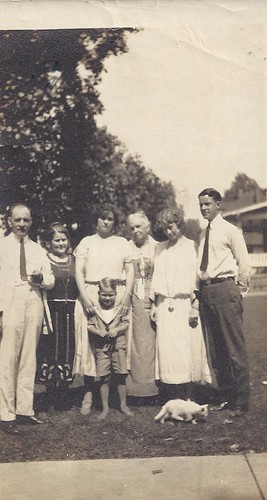
After hoping and hoping and hoping, I am thrilled to say that today my mom and I got to see a picture of Mary J “Annie” Bondurant, my second great-grandmother, for the first time.  A distant cousin, Joanne Stephens, through marriage (through the Curtius family, Annie’s second husband’s family) found a photo and emailed it to my mother.

Front 

Back

Written on the back is:

left to right-

Frank, Myself, Minnie

Mrs Richards Minnie’s Mother

lady who was a visitor from

Brownsville Tenn,

My dear son Paul.

front-

Baby Paul, 6 years old.

Household

Kitten

Made June 3rd 1923-

For Nellie & Joe, Ed. as Nellie knows these people-

So the people in the photo are:

Frank Curtius-Annie’s second husband

Mary J “Annie” Bondurant-my 2nd great-grandmother

Minnie Virginia Richards-my great-grandmother and Annie’s daughter-in-law

Minnie DeMumbrie-my 2nd great-grandmother and Minnie Virginia Richards’ mother

I’m not sure who the woman from Brownsville, Tennessee is, but she is a relative of some sort, I’m sure

James Paul Stalls, Sr-my great-grandfather, Annie’s son and Minnie Virginia Richards’ husband (first husband)

James Paul Stalls, Jr-my Granddaddy, Annie’s grandson, J. Paul and Minnie Virginia’s son, my mom’s daddy!